
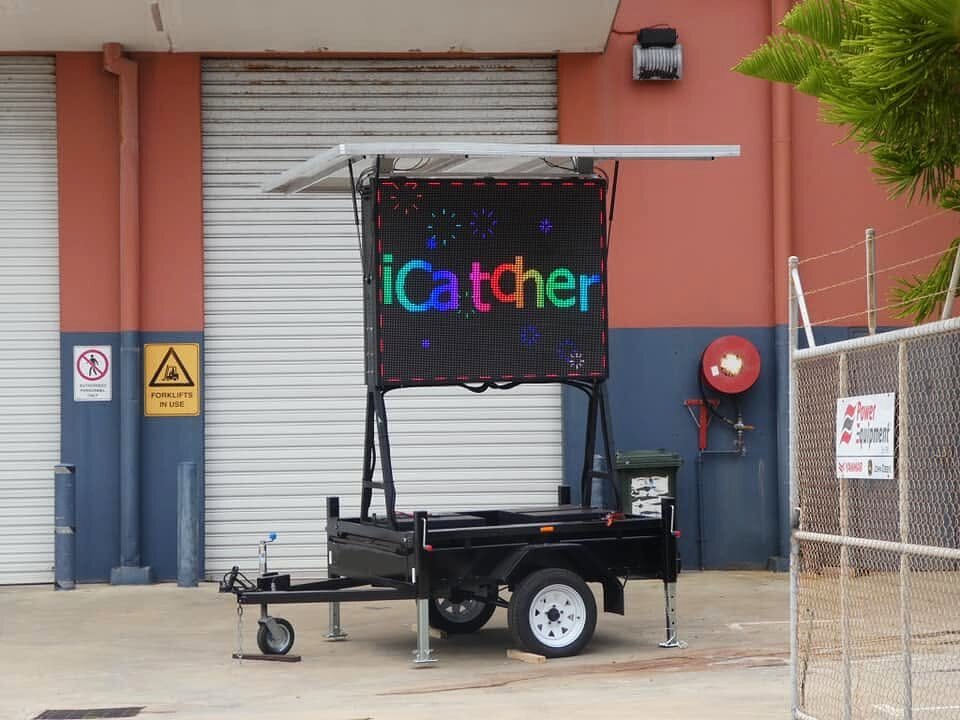
An outdoor LED sign that faces the sun needs to be thousands of nits bright to stay readable, and far less at night. Our FA2 outdoor screens reach up to 10,000 nits, bright enough for photos and video in direct sun. The right level changes through the day, so it helps to know how brightness is measured and how it is adjusted.
What a nit is
LED display brightness is measured in nits. A nit is the unit for how much light a screen gives off. One nit is one candela per square metre, which is roughly the glow of one candle spread over a square metre of screen. The higher the number, the brighter the screen.
For a sense of scale, a typical TV or computer screen gives off a few hundred nits. That is plenty in a lounge room and hard to see in the midday sun. Indoor LED screens usually run at about 600 to 1,200 nits. Outdoor LED signs use much brighter LEDs, so they can run many times higher.
Why direct sun needs more brightness
A sign is easy to read when the lit pixels stand out from everything around them. Sunlight lands on the face of the sign too, and it washes the picture out. The more sun on the face, the brighter the sign has to be to stay clear.
Which way the sign faces makes a big difference. Across most of Australia the sun sits in the northern sky, so a north-facing sign gets sun on its face for much of the day. A west-facing sign cops the afternoon sun, and an east-facing one the morning sun. A sign that faces south, or sits in shade, needs much less.
Photos and video suffer first. Pale colours and fine detail wash out early, while bold text on a dark background holds up better.
Why night needs less
At night the same sign at full power is too much. Letters bleed into each other, the sign glares at drivers, and it lights up the houses across the road. Turning it down after dark makes it easier to read, easier on the neighbours and easier on the power bill.
Brightness is also something approvals look at. Councils, and Main Roads WA for signs near main roads, consider how bright a digital sign is, and approval conditions can set limits for night time. Our guide to council approval for LED signs explains what usually applies in WA.
How LED screen brightness is adjusted
There are three common ways to set the brightness of an LED sign or screen:
- By hand: pick a level in the sign’s software and leave it there.
- On a schedule: set levels by time of day, so the sign dims in the evening and comes back up in the morning.
- Automatic: the sign follows a light sensor, so it brightens in full sun and dims under cloud.
The software for our signs covers this. ViPlex Express, VNNOX, LedArt and LED-Cloud all let you set the brightness by hand or on a schedule, and ViPlex Express, LedArt and LED-Cloud can follow a light sensor if one is fitted. The step-by-step guides on Brochures and Guides show where each setting is. When you talk to us about a sign, tell us which way it faces and how close it is to houses and roads, and we will suggest how to set it up.
Brightness and readability are different things
A brighter sign does not make small text readable from further away. That comes down to the size of the letters and the pixel pitch, which is the gap between the lights. Our guide to pixel pitch explains how to match the pitch to how far away people are.
A few habits help in any light:
- Use big, bold text on a dark background.
- Keep each screen to a few words if drivers are reading it.
- Avoid large areas of white, most of all at night.
Bright signs get hot
Running thousands of nits in an Australian summer makes heat, and heat is hard on electronics. The FA2 is fanless, runs without air conditioning up to 55 degrees and is sealed to IP68 against dust and heavy rain, which suits a sign that faces the sun all day.
Brightness on scoreboards
Scoreboards face the same sun as signs. On our scoreboards, Basic, the iCatcher Scoreboard app, sets the brightness by hand or on a schedule, so a board can run bright for a Saturday afternoon game and lower for night training. Advanced, Olympyx, has a brightness slider that dims the whole board for night games, and a Sun Mode that turns every word and number pure white, the brightest colour the panel has, for direct sun.
Ask us
See our outdoor LED screens and outdoor LED signs and pylon signs. Send us a photo of the spot and tell us which way the sign will face, and we will suggest a screen to suit.
Get a free quote, or call Aaron on 0416 053 335 or the office on (08) 9335 7944.
