
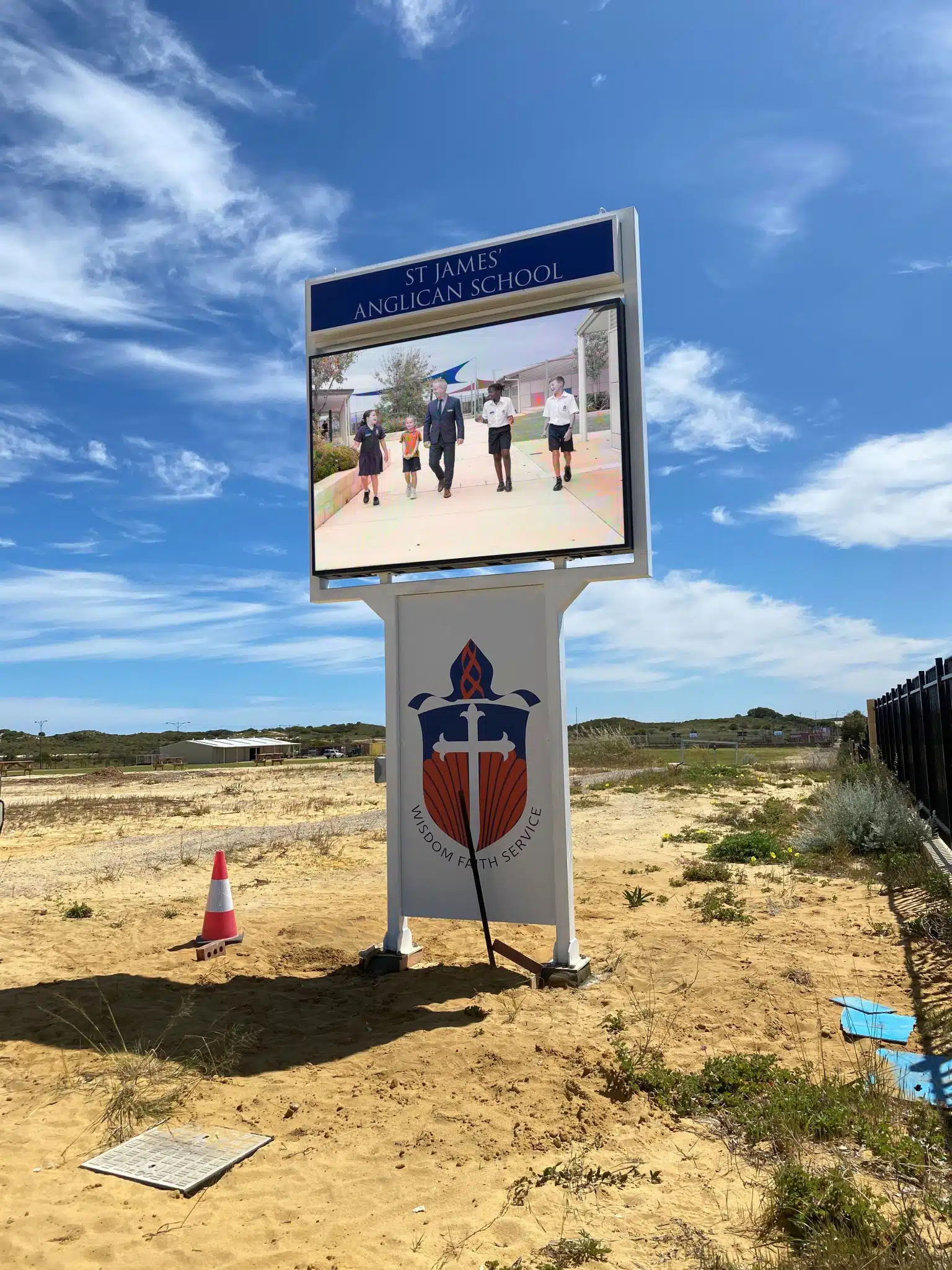
Do you need approval for an LED sign? For a permanent sign, the answer is almost always yes. In every state and territory, a sign that lights up, changes its message or plays video loses most of the exemptions a plain painted sign might get. And if drivers on a main road can see it, the state road authority usually gets a say too.
Here is what the official rules say in each state and territory, as we found them in October 2026. Rules differ from council to council and they change, so use this as a starting point and check with your council before you buy or install a sign. We help with the application as part of the job, at no extra cost.
The rules that come up everywhere
- Lit and changing signs need approval. Exemptions for small signs and business signs usually stop applying once a sign is lit, animated or electronic.
- Main roads bring in the road authority. Near a state road, a freeway or a busy intersection, the state road authority usually has to agree as well as the council.
- Each message has to stay up. Digital signs that drivers can see usually need a minimum time for each message, often 10 seconds or more, and an almost instant change to the next one.
- No video or animation facing traffic. Road authorities ban moving images and flashing on signs drivers can see, and several also ban effects such as fades.
- Dimmer at night. Most guidelines set brightness limits that drop at night, so the sign has to dim on a schedule or with a light sensor.
- Nothing that looks like a traffic signal. Signs must not look like traffic lights or give driving instructions.
- The landowner and heritage. You need the landowner’s consent, and a heritage place usually needs approval even for a small sign.
Western Australia
In WA, signs come under each council’s local planning scheme. A new permanent sign needs development approval from the council unless the council’s local planning policy exempts that kind of sign. The City of Perth’s exemptions, for example, don’t cover signs with animated or changing content.
If a digital sign is within 500 metres of a state road and can be seen from it, Main Roads WA has to approve it as well. Its guidelines for digital advertising signs set how long each message stays up, between 10 and 80 seconds depending on the road, ask for each change to happen within a tenth of a second, and limit brightness at night. Our guide to council approval in WA covers temporary signs too.
New South Wales
In NSW, signs come under Chapter 3 of the State Environmental Planning Policy (Industry and Employment) 2021, the state’s advertising and signage rules, and your council’s own plans. Most LED signs need a development application to the council, lodged through the NSW Planning Portal. Some pylon and projecting signs can take the faster complying development path instead. A lit sign can only be exempt if it doesn’t animate, flash or show moving images, and the exemption for school signs covers non-electronic signs only.
Transport for NSW has to agree to signs of 20 square metres or more within 250 metres of a classified road that can be seen from it. Its guidelines ask for each message to stay up for at least 10 seconds where the speed limit is under 80 km/h and 25 seconds at 80 km/h and above, with each change taking a tenth of a second. For signs in Sydney, see LED signs in Sydney.
Victoria
Every Victorian council’s planning scheme includes Clause 52.05 Signs. None of its categories makes an electronic sign permit-free, so you need a planning permit from the council. In some areas electronic signs are capped at 3 square metres, and in the most sensitive areas they are only allowed at service stations and freeway service centres.
An animated or electronic sign within 60 metres of a declared freeway or arterial road is also referred to the Head, Transport for Victoria, in the Department of Transport and Planning. The department’s guidelines for lit signs ask for changes in a tenth of a second or less and set brightness limits at night. Victoria has no statewide minimum time for each message; that is set in each permit. For signs in Melbourne, see LED signs in Melbourne.
Queensland
In Queensland, each council controls signs through its own local laws and planning scheme. Brisbane City Council has its own advertising device approval. An electronic display of 4 square metres or less can go ahead without approval if it meets the council’s rules, and anything bigger needs approval. Brisbane also asks for each message to stay up for at least 8 seconds where the speed limit is 80 km/h or less, and for lights to be off from 10 pm to 6 am within 100 metres of homes. The City of Gold Coast and other councils have their own local laws, so check with yours.
Near state-controlled roads, the Department of Transport and Main Roads gets involved. A sign inside the road corridor needs its permit, and signs that can be seen from state roads and motorways go to it through the council. Its Roadside Advertising Manual sets message times of 10, 15 or 25 seconds for electronic billboards, depending on the road. For signs in Brisbane and on the Gold Coast, see LED signs in Brisbane and the Gold Coast.
South Australia
In SA, signs are assessed under the advertisement policies of the Planning and Design Code, and you apply for development approval through PlanSA. A sign can only be exempt if it doesn’t move, flash or light up from inside, and a lit sign can’t take the quicker deemed-to-satisfy path, so an LED sign is assessed on its merits.
Near busy roads, the Department for Infrastructure and Transport’s guidelines for advertising signs apply. Each message stays up for at least 10 seconds where the speed limit is 60 km/h or less and 25 seconds above that, changes take a tenth of a second or less, and signs within 100 metres of traffic lights or signalised crossings are referred to the department. For signs in Adelaide, see LED signs in Adelaide.
Tasmania
Tasmanian councils use the Signs Code in the Tasmanian Planning Scheme. Lit signs, including LED screens, always need a planning permit and are assessed on their merits. A lit sign that can be seen from a nearby road must not look like it is flashing, animated or moving. The City of Hobart explains its process online.
Australian Capital Territory
In the ACT, lit, animated, flashing and digital signs whose message changes are not exempt, so they need a development application to the Territory Planning Authority, lodged online. School signs are the exception: a sign showing only school information, no more than 3.6 metres above the ground, is exempt as long as it isn’t both lit and animated. Vehicles and trailers showing signs can’t park on roads with a speed limit of 60 km/h or more.
Northern Territory
In Darwin, the City of Darwin’s outdoor advertising signs code applies. In commercial zones, lit signs of up to 3 square metres per premises don’t need a permit, but a sign that changes its message does, and those signs aren’t allowed in residential, community, rural and infrastructure zones. Outside the five municipal councils, an interim development control order sets the rules until 19 February 2027. Lit, electronic and trailer-mounted signs aren’t allowed in NT Government road reserves.
Hire signs and VMS boards
Temporary signs have their own rules. Parked advertising trailers are banned or tightly limited in Brisbane, on Queensland’s state-controlled roads, in Darwin and in NT Government road reserves, and in the ACT a vehicle or trailer showing a sign can’t park on a road of 60 km/h or more. In WA, Queensland, SA, Tasmania and the NT, VMS boards on roadworks show traffic messages only, not advertising, and they follow the traffic management plan for the job.
Tell us where a hire sign is going and we’ll help with council approval if the site needs it. See LED sign hire and what is a VMS board?
Scoreboards and sports grounds
Most of these rules don’t mention scoreboards at all, and no official source we found says whether a scoreboard that shows no advertising counts as a sign. Darwin is the clear exception: on council ovals, electronic and lit signs are only allowed on an electronic scoreboard, and only clubs with a current seasonal booking can apply. In Victoria, a sign at a major sports and recreation facility needs no permit if it can’t be seen from nearby land. If your scoreboard will show sponsors, or can be seen from a road or from neighbours, ask your council early. Our guide to scoreboard grants covers the landowner consent and approvals that grant programs ask for.
How we help
Our town planning service helps with the application at no extra cost, the same in every state. Brightness at night, the time each message stays up and how it changes are the settings councils and road authorities ask about. Our signs can dim on a schedule, or by themselves with a light sensor, and we set the software up for you.
Read how bright an outdoor LED sign should be and what affects the cost of an LED sign, or see our outdoor LED signs and pylon signs. Call Aaron on 0416 053 335 or the office on (08) 9335 7944, or use our contact page.
This is a general guide based on official government sources as we found them in October 2026. It isn’t legal advice. Rules differ between councils, zones and sites, and they change, so check with your council, and the road authority if your sign faces a main road, before you buy or install a sign.
